Concrete Proof: Robust Dolphin Echolocation Across Diverse Materials
Matthias Hoffmann-Kuhnt, Mandar A. Chitre, Vanessa Thexeira, Pengkun Hou, Jane Neo, and Ashley Benson
In Biennial Conference on the Biology of Marine Mammals (SMM 2026), 2026
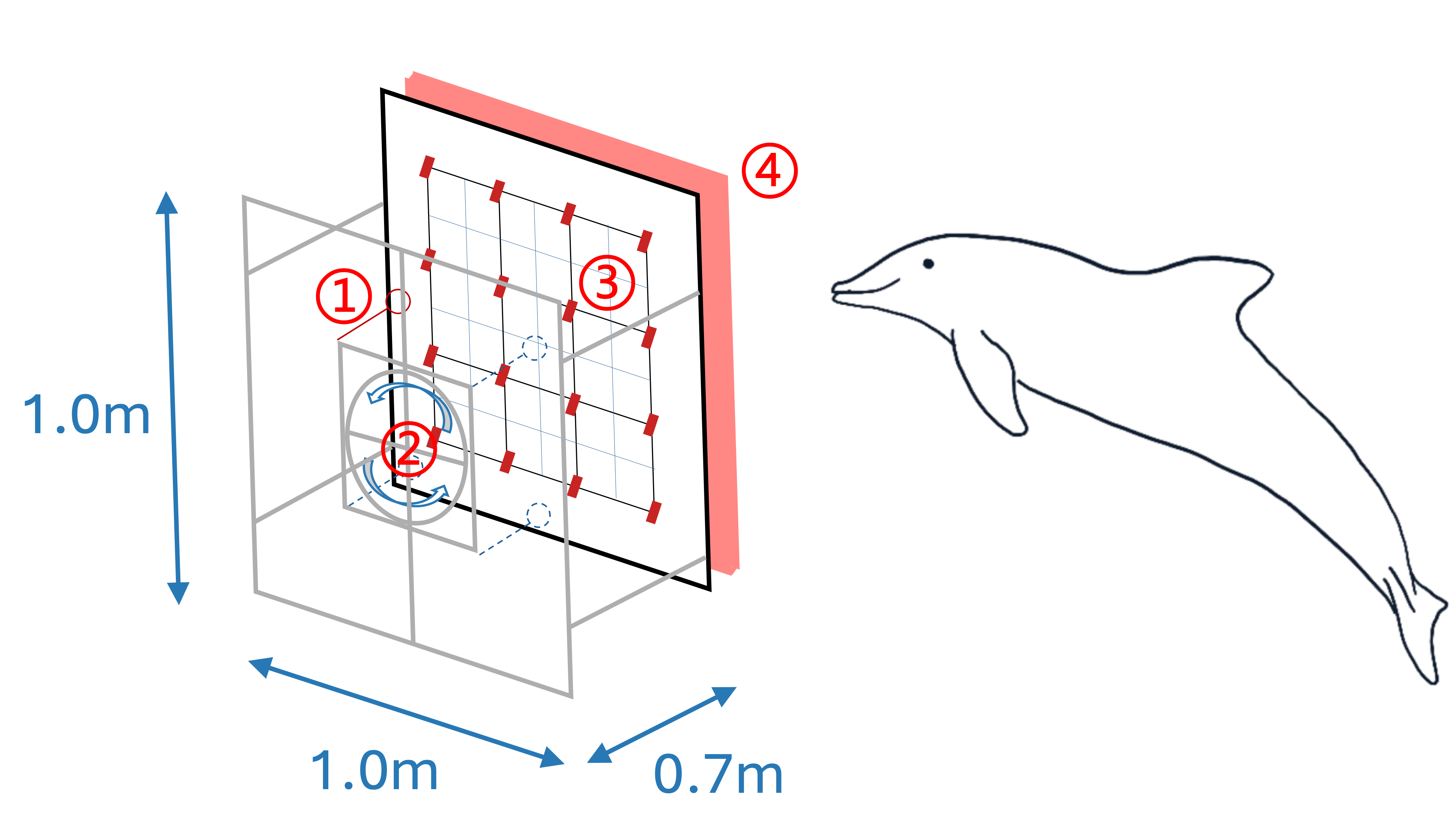
Several bottlenosed dolphins were trained to detect a 10cm air-filled spherical target behind a variety of different materials (opaque acrylic, PVC, stainless steel, aluminium, rubber and concrete) with the thickness of the materials varying from 2mm (stainless steel & aluminium) to 3, 5, 10 and 15mm (opaque acrylic) to 28mm (concrete). A planar 16-hydrophone array was mounted behind the materials to record the dolphin’s echolocation signals. Four different possible target locations at a fixed distance of approximately 15 cm behind the materials were used. All dolphins performed well above chance for any of the materials with at least 85% correct. Acoustic data was collected on the 16-hydrophone array at a frequency of 500 kS per second per channel. Two video cameras documented the dolphins’ detection behaviour: one was mounted above the material facing down and an underwater camera was mounted to the side of the test materials providing a side view. On both cameras the position of the target as well as the position of the dolphin was simultaneously visible. The cameras were synchronized with the acoustic recordings. Over 2000 test trials with the various materials were collected. The echolocation signals of each of the dolphins were extracted, analyzed and classified with machine learning algorithms. We present the acoustic data and the differences between the dolphins as well as changes and adaptations in the acoustics when the animals encountered a new and different material. The experiment demonstrates that even when echolocating through concrete the dolphins had no problems in finding the target and had very fine control over the echolocation signals they emitted.